

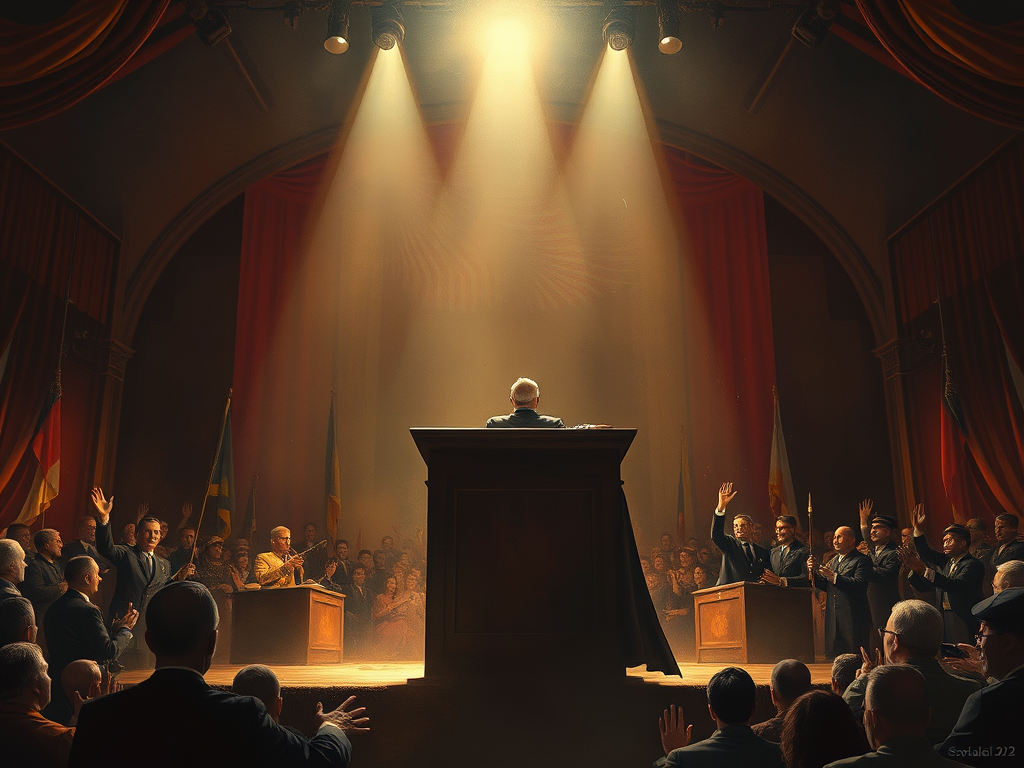
We like to think democracy is messy because it’s free — the noise of debate, the chaos of elections, the constant churn of ideas. But sometimes, that noise starts to feel like a distraction. The shouting, the outrage, the endless left-versus-right cycle — what if it’s not a symptom of democracy, but the disguise of something else entirely?
Maybe the chaos isn’t proof that we’re free. Maybe it’s the sound of our obedience.
Politics as Theatre
Every few years, we’re invited to play our part in the grand pageant of democracy. We vote, we argue, we tweet, we convince ourselves that the stakes are apocalyptic — and then, once the curtains close, the machinery behind the scenes hums on exactly as before.
Governments change, but interests endure. Defence spending stays sacred. Corporate donations flow regardless of who’s in office. The intelligence services, the civil service, the lobbying firms — all continue their quiet work, untouched by elections.
It’s not a conspiracy. It’s continuity. And continuity, as any empire learns, is the secret to control.
The real genius of modern governance isn’t censorship or dictatorship — it’s distraction. We’re kept busy fighting over the actors while the stagehands decide the story.
The Cult of the Enemy
Every system needs an enemy. Fear is the easiest way to rally a population and silence dissent. But in our era, the enemy doesn’t even have to be human. It can be a concept — terrorism, misinformation, extremism, disinformation.
These abstract threats are perfect because they never end. You can’t declare victory over an idea. So the fear remains constant, and with it, the justification for surveillance, militarisation, and the steady erosion of privacy.
As political theorist Carl Schmitt argued, sovereignty rests on the power to define the enemy. In modern democracies, that power has become industrialised. It’s no longer a political act — it’s a bureaucratic function. Every new “threat” justifies another budget increase, another layer of control, another reason to keep calm and carry on.
We are not meant to defeat our enemies. We are meant to need them.
The Military as the Quiet Sovereign
We pretend civilian politics directs the military. In reality, it often feels the other way around.
Across party lines and ideologies, defence budgets are untouchable. Politicians come and go, but the procurement contracts, the bases, the alliances — they persist. The military–industrial complex doesn’t vote, but it never loses an election.
When we talk about “national interest”, it’s often code for military interest — maintaining influence, deterrence, projection of power. These priorities trickle down into foreign policy, trade, even domestic policing. The language of security becomes the grammar of governance.
Elections rearrange the décor, but the command structure remains the same. The modern state has become, in essence, a standing army that occasionally hosts a talent show.
The Comfort of the Illusion
If democracy has become theatre, why do we keep showing up for the performance? Because belief is comforting. The rituals of democracy — voting, opinion polling, the televised debates — make us feel seen. They tell us we have agency, even when the outcomes are preordained.
There’s a strange tenderness in that illusion. We want to believe that our consent matters. We want to think our small choices ripple into change. It’s a flattering fiction, and the system depends on our willingness to keep believing it.
The philosopher Jean Baudrillard once wrote that politics today is “the simulation of choice.” The illusion works not because it deceives us, but because it comforts us. It tells us we’re still in the story.
Seeing Through the Stage Lights
Recognising the illusion isn’t an act of cynicism — it’s an act of clarity. Seeing how power operates doesn’t mean rejecting democracy outright; it means stripping away the theatre long enough to ask what democracy could be if it weren’t a performance.
Real democracy would mean transparency without PR management, participation beyond elections, accountability that can’t be deferred to “national security”. It would mean power that doesn’t need to hide behind spectacle, fear, or flag.
We’re not there yet. Maybe we never were. But awareness is the first step out of the script. Once you’ve seen the stage from the wings, it’s hard to be content just clapping along.
Maybe the illusion of democracy isn’t total control — maybe it’s just control made palatable. And perhaps that’s the most dangerous form of all: the kind that feels like freedom.
If you liked this article, maybe you would also like – The Illusion of Choice: Left Right and the Politics of Division which was really the starting point for everything I have talked about here today.

Leave a Reply to The Rational Disillusion: Why So Many Turn Away from Politics – Mentality's MindCancel reply